
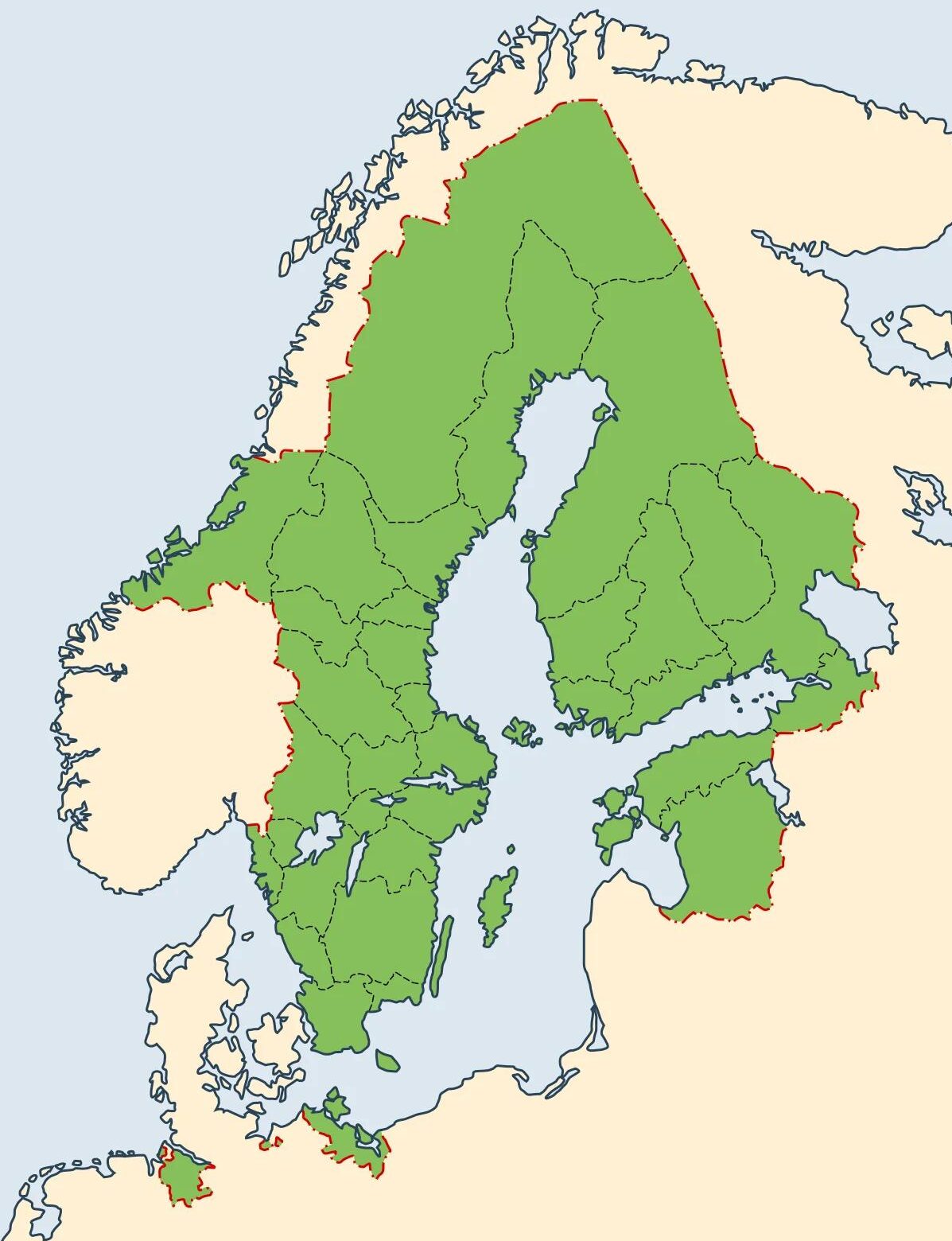
In the year 1669, when the larp is set, Sweden was at the height of its power, and one of the greatest kingdoms in Europe – at least when it came to military power and the amount of land controlled. Sweden was often at war, and the wars were sometimes lost, but often won. The entirety of what is today Finland, large parts of the Baltic states, and important trade cities in what is today Germany, were Swedish territory or controlled by Sweden. About ten years earlier, important agricultural areas that used to be Danish – Scania, Halland and Blekinge – were won in a war. The export of iron, copper and timber, all of which Sweden had plenty, were valuable sources of income for the state. In forested areas like Dalarna, where the larp takes place, people increasingly started to work producing charcoal, since charcoal was needed to make iron.
The king at the time was called Karl XI – but in 1669 he was only fourteen years old, and the country was run by a regency government headed by the king’s mother, the previous queen. For the first time in Swedish history, the centralised state had a decent amount of control over the population, though often through local nobility.
Over 90% of the population belonged to the peasantry/farming class/farming population. This included farmers who owned their own land, farmers who farmed land owned by the crown or nobility as well as groups like mining peasants. They had more influence over their life in Sweden than common people had in most of the rest of Europe – they were, for example, represented in the parliament. Nevertheless, life for these groups was often hard, not least because of the climate at the time which often led to very cold winters and bad harvests. Taxes were high, but could be adapted locally, to keep discontent from turning into rebellions. Since Sweden was almost constantly at war during the 17th century, most often against Denmark or Russia, men were constantly conscripted to the army, generally from the peasantry/farming class/farming population.
Relationships and gender roles
In the 17th century, men and women were considered opposites, meant to complement each other. Most parts of everyday life, including all work on the farms, were gendered. Going against the traditional division of labour was seen as going against the divine order, and could even be grounds for divorce in rare cases. In reality however, due to the constant wars, women could be found working in traditionally male areas and in leadership positions all over society in the mid-1600s. Even if this was in violation of contemporary norms, it was a socially acceptable violation. If a woman was widowed, she inherited the farm or business from her husband, and would keep it even if she remarried. Even if every woman (except for widows) would have a man who was technically in charge of her, the gendered divide of work meant that she could have a good deal of influence in her own sphere of interest.
The ideal man during the 1600s could control his emotions, acted with restraint and did not give in to desire or sin. Using excessive violence against his wife, or being tempted into sexual relations outside of marriage, could thereby be seen as an unmanly lack of self-control. Emotional expressions such as crying, however, seem to have been more socially accepted in the 1600s than in later times.
Marriage was highly encouraged by the church and by society, as healthy families were crucial for a well-functioning society. Both parties needed to consent to a marriage, and it was illegal to force anyone into marriage. However, marrying without parental consent was very rare, as parental approval was generally needed to ensure that the couple would be able to make a living. A marriage was essentially a business contract, with the business often being a small farm, and it was in everyone’s best interest that the business ran as smoothly as possible –
everyone ranging from the rest of the village to the government. This also meant that for many who weren’t the eldest son or had no hope of marrying an eldest son, marriage was an unattainable dream.
Sex within marriage was seen as something natural and important, also encouraged by society. Sex before marriage was technically illegal, but as long as there was an understanding and the couple married before a potential child was born, no one tended to mind. Infidelity, however, was seen as a serious crime and harshly punished. If both parties were married, any proven infidelity could lead to execution. If only one party was married, the punishment was lighter, in the form of either corporal punishments or heavy fines.
Homosexuality and queerness in 17th-century Sweden
Homosexuality did not exist as a word in 17th-century Sweden. It wasn’t until the Victorian era that sexuality became something tied to identity. Instead, sexuality in 17th-century Sweden was defined by actions. There were good sexual
actions and bad sexual actions. According to the church, all sexual actions outside of wedlock were bad, but in reality, in rural Sweden at the time, many had a more pragmatic way of looking at sexuality, especially in the military
and other situations where you were separated from your spouse, or many unmarried young people co-existed. No matter if it was premarital straight sex or same gendered sex. It was not a certain kind of person that was believed to
be more or less prone to homosexual acts. It had nothing to do with personality or identity but was just an action that anyone had potential to commit. The immorality in the action was important, not the immorality of the person
in general even if it of course never was a good thing to go against the church.
Female homosexuality was even more obscured by society’s failure to see sexual acts without penetration as real sex. Female closeness and companionship could exist in female spaces, such as in the summers when the womenfolk moved to the summer pastures with the animals to graze. Most such side steps were just not discussed, unless you have a bone to pick with someone. Then it could be a powerful tool to get someone in trouble.
There are some examples of female homosexuality making it to court, but then it seem to have been mainly an issue that they had used “tools”. In another case a person is caught not being biologically male despite being married to a
woman.
There are very few court cases regarding homosexual acts from this time, and the ones that are preserved almost always regard a very young victim and an adult offender. In these cases the younger part often gets a very mild punishment
in comparison to the older person who might even be exiled or put to death. The reason for how seldom homosexual relationships are brought to court is that it wasn’t really anything that you bothered to go looking for. Unlike
heterosexual sex outside of marriage that could lead to unwanted pregnancy the homosexual relationships were harmless as long as they weren’t discovered.
This more pragmatic view also extended to transgender identities. Work tasks, clothes, and even personality were strongly gendered during this time. But it was not unheard of for individuals to go against the norms, dressing in clothes
belonging to a different gender than they were born into, and sometimes pursuing careers and even marriage in this new gender role. If this was found out, it was, of course, a scandal and severely punished by the legal system, but
often it wasn’t noticed at all. There are several examples of wives “realizing” their husbands are actually females years after they got married, when the relationship has grown sour for other reasons, for example.
Religion, witchcraft and The Great Noise
During the 16th century, Sweden became a Protestant Lutheran country. The reason was political, but the beliefs spread, and by the mid-1600s, the common people were firmly Lutheran. All sermons were by then in Swedish rather than Latin, and the most common source for common people’s knowledge about Christianity and their faith was Luther’s Small Catechism – much more so than the source being the Bible itself. Catholicism (as well as all other religious beliefs) was forbidden, and during some periods (including in 1669) its practice could lead to exile or even the death penalty.
During the Medieval period in Sweden, people were occasionally punished for witchcraft, but only when it was claimed that they had committed another crime by using witchcraft (like murder, or theft). Witchcraft was the means, not the crime itself, and not yet a religious thing. It wasn’t until after the Protestant reformation that witchcraft became closely connected to the Devil, and witchcraft became a crime in and of itself.
The law which punished witchcraft with death was enacted in 1608, but a confession was needed from the accused for the death penalty to be administered, and the verdict had to be confirmed by the Royal Court (i.e Court of Appeals). For most of the 17th century it was very common with lighter sentences, or that the accused was judged innocent. This changed in 1668 – the first year of the Swedish witch trials, later known as The Great Noise. During this period, 1668-1676, almost 300 people lost their lives, most of them women.
The Great Noise started in Härjedalen, a province just north of Dalarna. The rumours and the panic began to spread, and witch trials sprang forth in many of the northern provinces, before at last reaching Stockholm and the southern parts of Sweden. The Royal Court wanted the unrest dealt with as quickly and discreetly as possible, in an attempt to avoid similar scenes as had been seen in other European countries. A Witchcraft Commission was formed and sent up north, from Stockholm, to preside over the trials and make sure that enough people were condemned for the people’s bloodthirst to be quenched, and to ensure that the unrest didn’t spread further. The Witchcraft Commission arrived in Mora, the largest town in Dalarna, in 1668. In August 1669, 23 people (22 women and one man) were executed for witchcraft. The larp is set roughly one month after the executions in Mora.
Many of the witnesses in the trials were children. The general belief at the time was that children weren’t yet as sinful as adults and as such, were more honest and truthful. The accusations were often that the accused had kidnapped and taken the children to Blåkulla, pronounced Blockula, a place where the Devil holds court. In many stories, the children were flown there at night on some sort of animal (like a cow or a hare), and there was dancing and revelry, large feasts and orgies, and things were done backwards or upside-down. The most famous child witnesses were believed to be able to see directly who was a witch or not.
The Great Noise compared to witch trials in other countries
The proceedings around witch trials differed from country to country. When translating and adapting The One Without Sin for an international audience, we have decided to stick to telling the story of Dalarna, Sweden, 1669, instead of opening the story up to be about historical witch trials in general. The main reasons for this is that we believe that we can tell a more cohesive story this way, and that we believe that this story is still worth telling, even if there might be others that are similar. This does mean, however, that if you have knowledge about how witch persecutions and trials took place in your country, that knowledge might not be fully relevant for this specific larp.
These are some of the most prominent and important aspects of the Swedish witch proceedings:
- The Swedish witch proceedings during 1668-1675, The Great Noise, were sanctioned by the state. Important and distinguished men with important titles were judges in official trials. In some other countries, the proceedings were more local and sometimes even discouraged by the government.
- In some other countries, women deemed guilty of witchcraft were burned alive. This practice was very, very rare in Sweden (there is only one single case confirmed) and the people judged guilty were generally first beheaded, then burned.
- The practice of torture to encourage a confession was rare in Swedish witch proceedings, which was not the case in every country. Most people who confessed to the crime of witchcraft likely did it to avoid being burned alive, or to ensure they would get the forgiveness of sins and thereby would go to Heaven.
- The practice of water testing the potential witch – tying her hands and feet together and then throwing her into a body of water, to see whether she floats or sinks (floating meaning being guilty of witchcraft) – was not commonly used during The Great Noise (but had been used in Sweden earlier)
- The view of children as innocents and therefore as particularly reliable witnesses was central during The Great Noise in Sweden. Many of the executed during these years were convicted because of children’s accusations. This was not as common elsewhere.
- In many countries, the “typical witch” who would be accused and executed, was poor, odd, or otherwise broke social norms, or were people who for a long time had been suspected to use witchcraft. During The Great Noise in Sweden, the “typical witch” was a middle-aged, well-known and respectable woman, who had not previously been suspected of any crime.
The last two bullet points are particularly important to remember, since they might feel counterintuitive or strange, but are important to many characters and how we aim to play the larp.